S&P500 Daily Action Areas & Price Targets 13/8/26
S&P500 Daily Action Areas & Price Targets 13/8/26
***QUOTING ES1! FOR CASH US500 EQUIVALENT LEVELS, SUBTRACT POINT DIFFERENCE***
SPX PUT/CALL RATIO 1.14 (The numbers reflect options traded during the current session.) A put-call ratio below 0.7 is generally considered bullish, and a put-call ratio above 1.0 is generally considered bearish.
GS Flow Desk: large S&P 31Aug 7000/7950 strangle in roughly $20mm vega / $115mm premium …My Read – classic “big convexity versus carry” trade: either someone paid a lot to own a wide August move, or someone got paid a lot to bet that the S&P stays comfortably inside the 7000–7950 corridor
JHEQX Q3 Collar Short Call Cap: ~7,750 – 7,900 - Long Put Strike: ~7,050 – 7,100 (approx. 5% downside protection) Short Put Strike: ~5,950
DEC2025 OPEX to DEC2026 OPEX is 945 points giving us a range of [5889,7779]
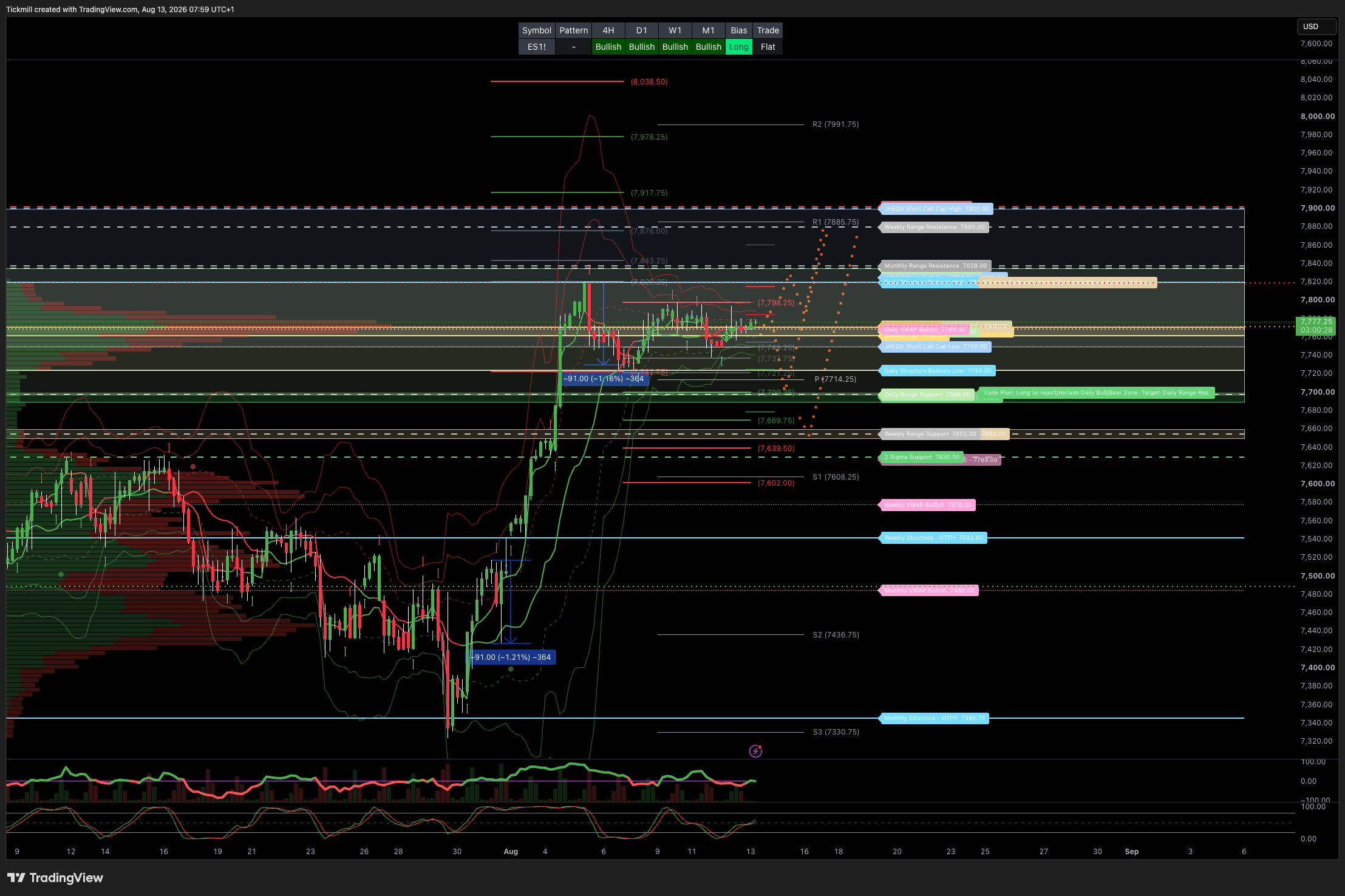
WEEKLY BULL BEAR ZONE 7660/50
WEEKLY RANGE RES 7880 SUP 7655
MONTHLY RANGE RES 7838 SUP 7258
DAILY VWAP BULLISH 7769
WEEKLY VWAP BULLISH 7578
MONTHLY VWAP BULLISH 7485
DAILY STRUCTURE - BALANCE - 7820/7724
WEEKLY STRUCTURE - OTFH - 7542
MONTHLY STRUCTURE - OTFH - 7345.75
Balance: This refers to a market condition where prices move within a defined range, reflecting uncertainty as participants await further market-generated information. Our approach to balance includes favouring fade trades at the range extremes (highs/lows) while preparing for potential breakout scenarios if the balance shifts.
One-Time Framing Higher (OTFH): This represents a market trend where each successive bar forms a higher low, signalling a strong and consistent upward movement.
One-Time Framing Lower (OTFL): This describes a market trend where each successive bar forms a lower high, indicating a pronounced and steady downward movement.
DAILY BULL BEAR ZONE 7700/7690
GAMMA FLIP 7762
DELTA FLIP 7771
DAILY RANGE RES 7835 SUP 7698
2 SIGMA RES 7902 SUP 7630
VIX BULL BEAR ZONE 17.9 (VVIX / VIX) 6.08
TRADES & TARGETS
LONG ON REJECT/RECLAIM DAILY BULL BEAR ZONE TARGET DAILY RANGE RES
***ADDITIONAL SETUPS & TARGETS HIGHLIGHTED ON THE CHARTS***
(I FADE TESTS OF 2 SIGMA LEVELS ESPECIALLY INTO THE FINAL HOUR OF THE NY CASH SESSION AS 90% OF THE TIME WHEN TESTED THE MARKET WILL CLOSE ABOVE OR BELOW THESE LEVELS)
GOLDMAN SACHS FICC & EQUITY TRADING DESK VIEWS
Post-CPI Update — Core PCE Marked Lower, Sept Hike Odds Fall, NDX Vol Compresses Further
The CPI release appears to have been benign enough to lower the downstream core PCE estimate and reduce Fed hike pricing. The immediate macro read is supportive for risk assets:
core PCE estimate revised to +0.23% from +0.26%
core PCE YoY now estimated at 3.27%
market pricing only 38% odds of a September hike
S&P implied move for the rest of the week only 63bps
vol desk quiet despite CPI and AI headlines
NDX vol initially rose, then collapsed as spot firmed
The core message:
CPI did not deliver the hot-print shock that rates markets feared. It lowered core PCE tracking, reduced September hike odds, and restored the “spot up / vol down” regime, but NDX-specific vol has compressed so aggressively that the desk now prefers defined-premium upside call spreads rather than outright long convexity.
1. Macro Read: CPI Lowers Core PCE Tracking
Updated estimate:
Metric | Post-CPI Estimate |
|---|---|
Core PCE MoM | +0.23% |
Prior pre-release estimate | +0.26% |
Core PCE YoY | 3.27% |
The revision lower from +0.26% to +0.23% matters because it suggests CPI details were softer in PCE-relevant categories.
This reduces the probability that the Fed needs to respond hawkishly at the September meeting.
Market pricing now shows:
38% chance of a September hike
That is meaningfully below a coin flip.
2. Policy Implication: Inflation Risk Eases, But Not Eliminated
A +0.23% core PCE print is not an outright “inflation is dead” number, but it is manageable.
Annualized:
0.23%×12=2.76%0.23%×12=2.76%
That remains above the Fed’s target, but it is not alarming enough to force an immediate hike if labor and activity data are softening.
The Fed read:
no urgent need to hike on this CPI
September remains data-dependent
next inflation print still matters
retail sales / labor data will influence the balance
policy-sensitive assets can breathe
This fits the earlier framework:
If higher real yields are being driven partly by structural AI capex demand rather than cyclical overheating, the Fed does not need to chase the bond market higher with policy rates.
3. Equity Market Read: Risk Assets Get the Green Light, But Vol Stays Heavy
The CPI outcome likely supports:
equities
small caps
duration-sensitive growth
select Tech / NDX
gold if yields soften
cyclicals if growth remains intact
But vol behavior is notable.
Despite CPI and AI-focused announcements, it was a quiet day on the vol desk.
NDX vol was up in the morning but came in hard as the session progressed.
The market reverted to:
Spot Up+Vol DownSpot Up+Vol Down
That means investors did not chase protection after CPI. Instead, event premium decayed.
4. NDX Vol Compression Remains Extreme
The NDX 1-month implied vol spread versus SPX continues to compress.
The note says the spread registered its most dramatic 10-day downside change on a 5-year lookback.
This is important because it confirms a major repricing of Tech optionality.
Earlier:
NDX futures positioning swung sharply bearish
NDX single-stock vol collapsed
investors reduced AI / Tech optionality
AI baskets lagged ex-AI
NDX-to-SPX vol spread compressed
Now, even after CPI and AI-related headlines, NDX vol continues to deflate.
The market is effectively saying:
Tech is still important, but investors are no longer willing to pay a large premium for NDX convexity.
5. Why the Desk Likes Short-Dated QQQ Call Spreads
Given compressed NDX vol and upside breakout potential, the desk likes:
short-dated QQQ call spreads
out to end of August
Rationale:
defined premium
defined downside
lower cost than outright calls
benefits from upside breakout
avoids overpaying for vol
fits event calendar into NVDA / Jackson Hole
captures potential NDX catch-up after vol compression and underpositioning
This is a clean expression because it matches the market structure:
NDX vol is lower
upside risk remains
positioning may be light
CPI did not hurt risk
AI financing headlines may revive interest
NVDA earnings are approaching
The trade construction logic:
Buy QQQ Call−Sell Higher Strike QQQ Call=Defined-Risk Upside ExposureBuy QQQ Call−Sell Higher Strike QQQ Call=Defined-Risk Upside Exposure
6. Flow Confirmation
Flows showed several implementations of the QQQ upside play through:
end-August call spreads
October call spreads
This indicates investors are beginning to position for NDX upside, but still prefer premium control.
That is important psychologically:
Investors want upside exposure, but not unlimited option premium burn.
So this is not euphoric call chasing. It is more disciplined upside re-engagement.
7. S&P Event Pricing for Rest of Week
The S&P implied move for the rest of the week is:
63bps
Using a rough S&P level near 7,728–7,750, that implies about:
7,740×0.0063≈48.87,740×0.0063≈48.8
or roughly ±49 S&P points for the rest of the week.
That is still a relatively contained implied move.
The market has moved past CPI without a vol repricing and is now focused on:
PPI
retail sales
Fed speakers
NVDA earnings setup
Jackson Hole
AI financing developments
8. Post-Bell Earnings
COHR: -5% After Hours
COHR fell around 5% post-bell despite having rallied 8% during the regular session.
Reported:
beat / guide above
EPS beat by roughly 7%
The after-hours weakness likely reflects:
profit-taking after the day’s rally
high expectations
guidance not enough versus whisper numbers
AI/optical sentiment already priced in
margin / mix concerns possible
This is consistent with the current earnings regime:
Beats are not enough if expectations are already elevated.
CSCO: +2% After Hours
Cisco rose around 2%.
Key details:
beat / raise
revenues accelerated to +18% YoY in fiscal 4Q
fiscal 1Q gross margins guided to 65–66%
versus fiscal 4Q gross margins of 66.3%
The positive is clear:
revenue acceleration
beat / raise
networking / AI infrastructure relevance
The caution:
gross margins guided down sequentially
Still, the market treated it positively, likely because growth acceleration matters more than a small GM step-down.
CBRS: -11% After Hours
CBRS fell around 11% after closing up 12% on the day.
Results / guide:
Metric | Result / Guide | Consensus |
|---|---|---|
Core revenue | US$210m | US$194m |
Core gross margin | 41% | — |
3Q revenue guide | US$214–216m | US$212m |
3Q core GM guide | 38–40% | — |
Despite beating and guiding revenue slightly above consensus, the after-hours reaction was negative.
Likely reasons:
stock had already rallied hard
gross margin guide down from 41% to 38–40%
guide not high enough relative to expectations
event risk around Supernova on August 18
investors wanted more detail but press release gave no agenda color
The key catalyst:
Supernova event on August 18
No agenda details were provided, which may have disappointed investors looking for a clearer product / AI catalyst.
9. AI Financing Theme Continues
The note references AI-focused announcements overnight, following the Nvidia US$500bn financing partnership narrative.
This keeps the market focused on:
vendor financing
compute infrastructure
private credit
data-center debt
AI capex
alt managers
hyperscaler financing
capital formation around compute
The equity market is currently treating the theme as supportive, but the reflexivity risk remains.
Bull case:
Financing Partnerships→More Compute Buildout→More AI Revenue→Higher EarningsFinancing Partnerships→More Compute Buildout→More AI Revenue→Higher Earnings
Bear case:
Vendor Financing→Financed Demand→Circular Revenue Risk→Future Capex Air PocketVendor Financing→Financed Demand→Circular Revenue Risk→Future Capex Air Pocket
For now, CPI helped remove the immediate rates shock, giving the AI financing narrative more room to work.
10. Tactical Market Setup
Bullish Elements
CPI lowered core PCE tracking
September hike odds down to 38%
vol decayed after event
NDX vol spread to SPX compressed sharply
QQQ call spreads gaining interest
small caps remain sensitive to lower yields
AI financing theme still active
S&P rest-of-week implied move only 63bps
Cautionary Elements
core PCE YoY still 3.27%
September hike not fully priced out
real yields remain high
NDX vol compression could reflect complacency
post-bell earnings reactions show high bars
AI-related beats may still be sold if expectations are stretched
next catalysts remain significant
11. ES / SPX Overlay
The prior ES range was:
7724 support
7751 pivot
7800 range high / breakout trigger
upside levels: 7820 / 7845 / 7893
The CPI outcome should help ES hold the pivot / upper range bias.
If spot can accept above 7800, the path remains:
7800→7820→7845→78937800→7820→7845→7893
A failure to hold 7751 after benign CPI would be a warning that the market is losing momentum despite macro support.
Disclaimer: The material provided is for information purposes only and should not be considered as investment advice. The views, information, or opinions expressed in the text belong solely to the author, and not to the author’s employer, organization, committee or other group or individual or company.
Past performance is not indicative of future results.
High Risk Warning: CFDs are complex instruments and come with a high risk of losing money rapidly due to leverage. 68% and 74% of retail investor accounts lose money when trading CFDs with Tickmill UK Ltd and Tickmill Europe Ltd respectively. You should consider whether you understand how CFDs work and whether you can afford to take the high risk of losing your money.
Futures and Options: Trading futures and options on margin carries a high degree of risk and may result in losses exceeding your initial investment. These products are not suitable for all investors. Ensure you fully understand the risks and take appropriate care to manage your risk.
Patrick has been involved in the financial markets for well over a decade as a self-educated professional trader and money manager. Flitting between the roles of market commentator, analyst and mentor, Patrick has improved the technical skills and psychological stance of literally hundreds of traders – coaching them to become savvy market operators!