FTSE Edges Higher to Cap Strong Weekly Gains as Aviva and Energy Counter Tech Jitters
FTSE Edges Higher to Cap Strong Weekly Gains as Aviva and Energy Counter Tech Jitters
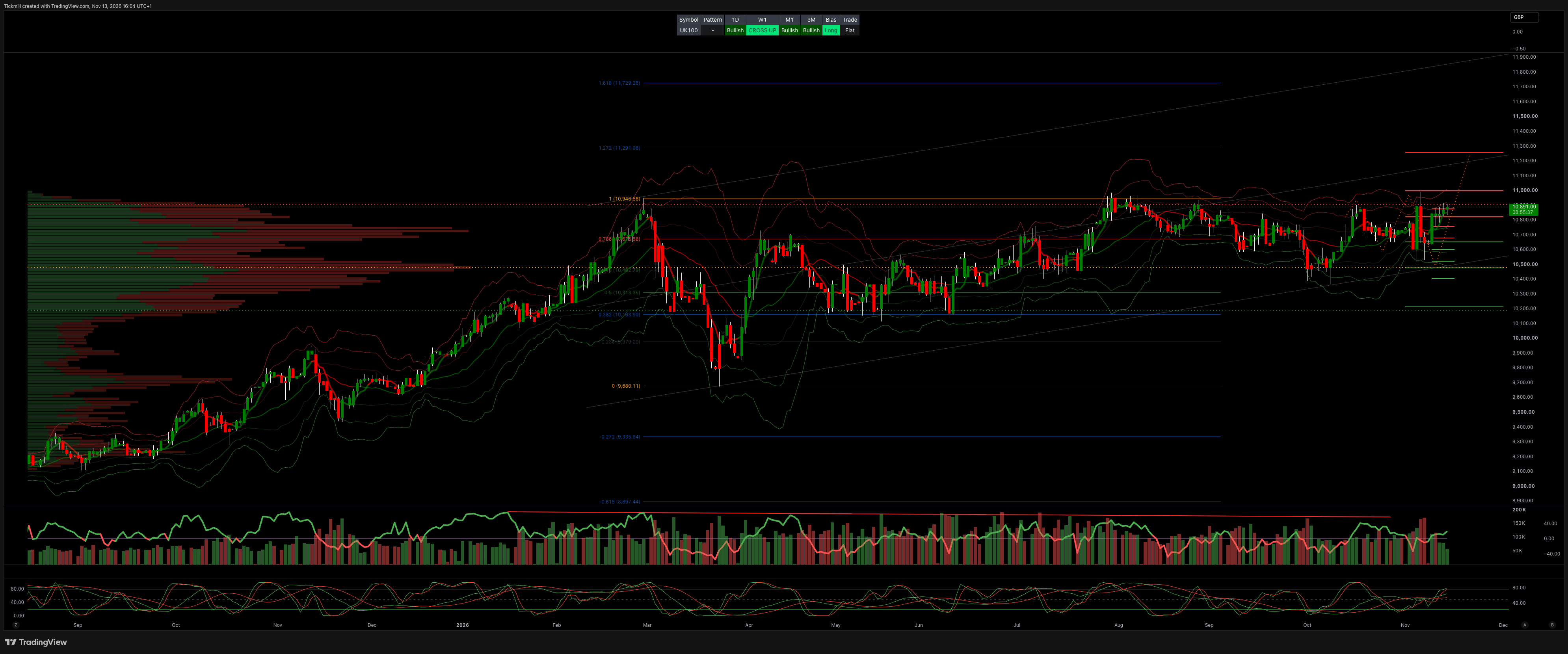
London's benchmark FTSE 100 edged slightly higher on Friday, gaining roughly 0.14% to trade near 10,878 points (after touching an intraday high of 10,897.99) and locking in its strongest weekly showing in roughly a month. Investors navigated a cautious session, balancing strong domestic insurance and energy updates against global technology jitters triggered by Nvidia CEO Jensen Huang's resignation, alongside growing market pricing for a December Federal Reserve rate hike and an over 82% probability of another Bank of England increase next month.
Insurance, utilities, and energy heavyweights propelled top-flight risers. Insurer Aviva climbed 2.5% to 2.7% after delivering a standout nine-month trading update, reporting a 19% surge in general insurance premiums to £11.8 billion (driven by a 27% jump in the U.K. and Ireland to £8.5 billion, with Canada up 2% on a constant currency basis to £3.3 billion), alongside a 19% rise in assets under management to £267 billion, a 31% increase in net flows to £10.9 billion, and wealth customer numbers surpassing 6.1 million. Utility giant Centrica rallied nearly 3.5%, while steady gains of 1.0% to 1.5% lifted SSE, Shell, BP, Ithaca Energy, Compass Group, and Associated British Foods. Commercial property landlord Land Securities advanced 1% after posting higher fiscal first-half attributable profit and revenue. Broad defensive and financial buying also pushed Legal & General, The Sage Group, Burberry Group, Severn Trent, Games Workshop, Prudential, Admiral Group, National Grid, AstraZeneca, and GSK into positive territory.
Conversely, private equity, aerospace, and precious metal miners dragged on broader upside. 3i Group drifted 2.5% lower, while pullbacks between 1.0% and 1.7% weighed on WPP, Weir Group, Vodafone Group, Babcock International, Computacenter, Barratt Redrow, ICG, and Rolls-Royce Holdings. Precious metal miners extended their weekly slump—slipping 0.6% on the day and tracking a weekly drop exceeding 6%—amid softer bullion prices.
Commodity and geopolitical cross-currents remained front and center. Crude oil prices rebounded after U.S. President Donald Trump indicated that Washington could forgo a diplomatic deal with Tehran, stoking fresh supply anxieties. Front-month Brent crude futures briefly touched $96.81 a barrel before settling near $96.17, up 0.35% from the prior close.
Looking ahead to next week, the U.K. faces a pivotal economic data docket that will shape near-term monetary policy expectations. Tuesday brings the latest U.K. labor market report, followed on Wednesday by October Consumer Price Index (CPI) figures. Traders and policymakers will scrutinize the inflation print against the Bank of England's 3.7% year-over-year forecast, a crucial benchmark that will likely determine whether Governor Andrew Bailey and the MPC opt for an immediate December rate hike or adopt a more measured stance into February.
Finish Line: U.K. equities closed out a resilient week on a steady footing, as robust insurance results from Aviva and rebounding energy heavyweights buffered the FTSE 100 against global tech turbulence and defense profit-taking. With the benchmark holding firmly near the 10,880 threshold, market focus pivots directly to next week's U.K. jobs and inflation releases for clarity on the Bank of England's December rate path.
Disclaimer: The material provided is for information purposes only and should not be considered as investment advice. The views, information, or opinions expressed in the text belong solely to the author, and not to the author’s employer, organization, committee or other group or individual or company.
Past performance is not indicative of future results.
High Risk Warning: CFDs are complex instruments and come with a high risk of losing money rapidly due to leverage. 68% and 74% of retail investor accounts lose money when trading CFDs with Tickmill UK Ltd and Tickmill Europe Ltd respectively. You should consider whether you understand how CFDs work and whether you can afford to take the high risk of losing your money.
Futures and Options: Trading futures and options on margin carries a high degree of risk and may result in losses exceeding your initial investment. These products are not suitable for all investors. Ensure you fully understand the risks and take appropriate care to manage your risk.
Patrick has been involved in the financial markets for well over a decade as a self-educated professional trader and money manager. Flitting between the roles of market commentator, analyst and mentor, Patrick has improved the technical skills and psychological stance of literally hundreds of traders – coaching them to become savvy market operators!